
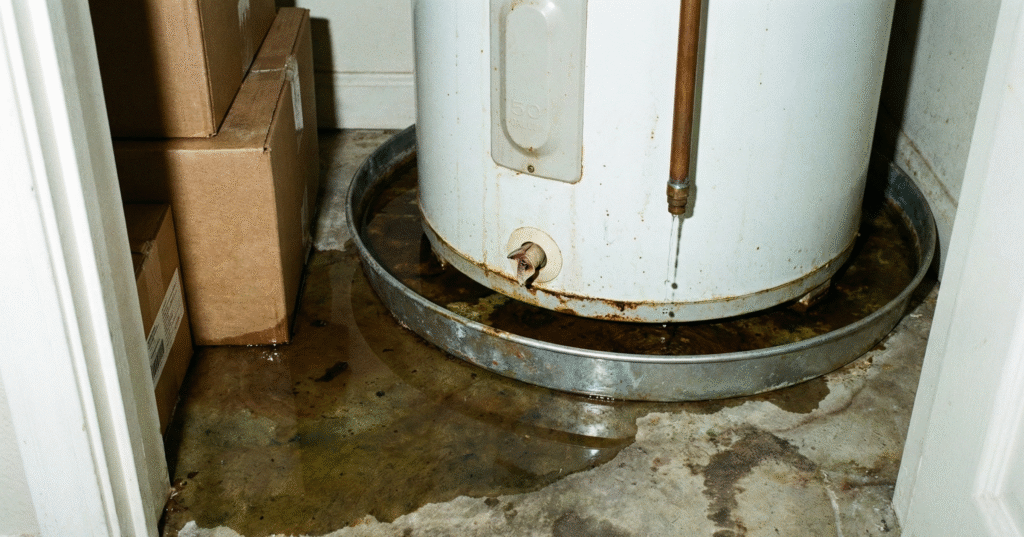
Finding a puddle of water around the base of your tank is a stressful moment for any homeowner. A water heater leaking isn’t just an inconvenience or a sign of a cold shower in your near future; it is an immediate threat to your home’s structure.
Even a slow drip can release gallons of water over time, saturating flooring, warping subfloors, ruining drywall, and creating the perfect environment for mold growth. In many cases, by the time you notice the water spreading on the floor, the water heater leak has been active for days or even weeks behind the scenes.
At Emergency Restoration Xperts (ERX), we frequently deal with the catastrophic water damage caused by failed water heaters. While our job is cleaning up the mess and restoring the property, it is crucial for homeowners to understand why the leak is happening in the first place. Here are the five most common hidden causes of a water heater leaking and what they mean for your home.
1. The Drain Valve is Loose or Faulty
If you notice water pooling right at the bottom of the tank, the first place to check is the drain valve. This is the spigot near the bottom used to empty the tank for maintenance and remove sediment buildup. It often looks like a standard garden hose connection.
Over time, this valve can rattle loose due to normal vibrations, or the rubber washer inside it can dry out and wear out, causing a steady drip. Sometimes, simply tightening it carefully with a wrench can solve the issue. However, if the valve itself is made of plastic and has cracked, or if the threads are damaged, it will need to be replaced by a professional plumber.
2. Too Much Pressure (The T&P Valve)
Every water heater has a Temperature and Pressure (T&P) relief valve located on the side or top of the tank with a discharge tube pointing down toward the floor. This is a critical safety feature. Water expands when heated, and if it has nowhere to go, pressure builds inside the tank. If the water gets too hot or the pressure builds too high, this valve automatically opens to release some water and prevent the tank from exploding.
If you see water dripping from the T&P valve tube, it means the valve is doing its job, but it also means you have a dangerous pressure or temperature problem that needs immediate attention. This could be due to a faulty thermal expansion tank or excessively high municipal water pressure. Crucially, never cap or plug this valve to stop the leak.
3. Loose Inlet or Outlet Connections
Check the top of your water heater where the cold water pipe enters and the hot water pipe exits. If you see water trailing down the side of the tank from above, or pooling on top of the unit, the leak is likely at these connection points.
These connections can loosen over time due to the constant heating and cooling cycles that cause metal pipes to expand and contract slightly. Sometimes tightening these connections with a pipe wrench solves the problem. However, if the pipes themselves are heavily corroded or rusted due to a slight, long-term weep, they may need replacing by a plumber.
4. An Internal Tank Crack
This is the scenario homeowners dread most. Over years of use, the constant reheating of water causes the inner metal tank to expand and contract thousands of times, eventually leading to stress fractures in the steel. Furthermore, minerals and sediment in the water settle at the bottom of the tank, corroding the shell from the inside out.
If the actual internal body of the tank has cracked, water will usually leak heavily from underneath the unit, rushing out faster than the supply line can fill it. Unfortunately, an internal crack cannot be repaired; the entire water heater must be replaced immediately to prevent a massive catastrophic flood.
5. The Tank Is Just Too Old
Like any appliance, water heaters have a limited lifespan. Most traditional tank-style heaters are built to last between 8 and 12 years, depending on water quality and maintenance.
If your unit is pushing a decade old and you find your water heater leaking, it is likely just reaching the end of its service life. The internal components, seals, and glass liner have likely corroded to the point of failure. In this case, replacement is usually the most cost-effective and safest option before a total rupture occurs.
Immediate Steps to Take When You Find a Leak
Before you call a plumber or ERX, safety must be your first priority. Water heaters involve both electricity/gas and water, a dangerous combination. If you discover a significant water heater leak:
- Turn Off the Power/Gas: For electric heaters, go to your circuit breaker panel and flip the breaker labeled for the water heater. For gas heaters, locate the gas shut-off valve on the line leading to the heater and turn it off, or turn the dial on the heater’s thermostat to “OFF” or “Vacation Mode.”
- Turn Off the Water Supply: Locate the cold water inlet pipe at the top of the tank. There should be a shut-off valve (either a wheel handle or a lever). Turn this clockwise to stop new water from entering the tank.
- Clear the Area: Move any boxes, furniture, or porous items away from the water to prevent further damage.
- Document the Damage: Before moving too much, take a few photos of the standing water for insurance purposes.
Why The “Plumbing Fix” Isn’t Enough
Many homeowners believe that once the plumber swaps out the old tank for a new one, the problem is solved. While a plumber can fix the appliance, the biggest risk isn’t just the broken tank; it’s the water damage you don’t see.
Plumbers are experts at pipes and appliances, but they do not carry the specialized equipment needed to dry out structure. If a leak has been happening undetected for days, water has likely seeped under tile or vinyl flooring, soaked into baseboards, wick up into drywall, and saturated insulation.
Simply fixing the leak won’t dry out that trapped moisture. That trapped moisture becomes a breeding ground for bacteria and mold. According to the CDC regarding mold growth, mold can begin to develop on damp surfaces within 24 to 48 hours.
When to Call ERX for Water Damage
If your water heater leak has resulted in significant standing water, saturated carpets, or wet drywall, you need more than a plumber; you need restoration experts.
Plumbers fix the appliance; ERX fixes the damage caused by the water. You should call our professional water mitigation team if:
- There is standing water covering a large area of flooring.
- Water has migrated into adjacent rooms or hallways.
- You smell a musty odor near the leak site.
- Baseboards or drywall feel soft or damp to the touch.
Final Thoughts: Don’t Wait
A leaking water heater is a ticking clock. Addressing it immediately is the key to preventing a minor inconvenience from turning into a major, expensive restoration project.
If a failed water heater has flooded your home or business, call Emergency Restoration Xperts (ERX) right away. We are available 24/7 to extract the water, dry out your structure, and ensure your property is safe.
Reach us anytime at (828) 639-8208 to get ahead of the water damage before it spreads.